
How Banning Fluoridation Will Impact Kids
For the first time since it began in 1945, community water fluoridation was banned in 2025 by the states of Florida and Utah. In 2026, more states will consider bills that would either ban fluoridation or weaken laws that guarantee access to fluoridated water. A new research brief by the CareQuest Institute for Oral Health (CQI) predicts how much state bans would increase tooth decay and estimates the cost of treating it in low-income children.
Numbers of Children
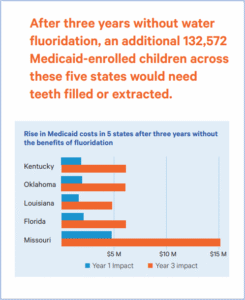
Carequest.org: How Ending Water Fluoridation Would Affect Children and State Medicaid Costs
Analyzing dental claims data, CQI found that tens of thousands more children insured by Medicaid are likely to require restorative treatment or extractions in states that ban community water fluoridation. This study used data that was available from five states to derive its projections: Florida, Kentucky, Louisiana, Missouri, and Oklahoma. Nationwide, nearly half of all children are enrolled in Medicaid and CHIP insurance programs.
CQI predicts that if Kentucky were to ban fluoridation, in as little as three years an additional 25,235 children would require treatment or extractions. Florida has already banned water fluoridation. Based on CQI’s analysis, after three years without fluoridation, an additional 52,131 children will need at least one filling or extraction of a decayed tooth.
Costs to States
Treating more decay would raise the dental costs of state Medicaid programs. If Oklahoma were to ban fluoridation, CQI’s brief estimates that its state Medicaid program would spend nearly $6.3 million more on fillings and extractions than it currently spends. If Missouri were to follow the same course as Florida, the research projects that the state Medicaid program would see its costs rise by over $15 million.
These estimated impacts reinforce a key message from the National Institute of Health’s 2021 Oral Health in America report. “Decreasing health disparities depends in large part on programs and policies aimed at providing more equitable distribution of evidence-based, health-promoting interventions,” the NIH report observed. “Generally, this means programs that are not dependent on individual behavior change or compliance, such as community water fluoridation programs.”
And So Much More
It’s important to understand what the numbers in CQI’s brief do not include. People of all ages and all income levels benefit from fluoridation to different degrees. CQI focused on children who are enrolled in Medicaid. For this reason, its research was not designed to predict the impact of banning community water fluoridation on children who either lack any dental insurance or have commercial coverage. More than one in three children in families with income 300% or more above the federal poverty level have had tooth decay, a prevalence rate that is likely to increase where fluoridation is discontinued.
Cavities are the most common chronic childhood disease, and often go untreated. This can cause pain and lead to infections that make it difficult for children to sleep, eat, speak, concentrate, and thrive. Parents and teachers know that the health effects of untreated tooth decay, effects they see every day, are supported by research. A North Carolina study found that children with recent tooth pain were three times more likely to be absent from school. A California study found that kids with recent tooth pain were four times more likely to receive below-average grades.
Although CQI’s research does not explore the likely impact that statewide fluoridation bans would have on low-income adults, the brief nonetheless includes a section on page 4 reinforcing the positive role that fluoridation plays in adults’ oral health.
Read a summary of How Ending Water Fluoridation Would Affect Children and State Medicaid Costs here, and click this link to download a PDF.